 Bible Archivist
March 12, 2026 · John Adams
The Ancient Near East Hospitality Code: 7 Rules That Governed Biblical Life
Discover the ancient Near East hospitality code — why washing feet, welcoming strangers, and opening your tent were legal duties with life-or-death stakes, not polite gestures.

In the ancient Near East, hospitality was not a virtue — it was a legal obligation with life-or-death stakes.
When Abraham rushed out of his tent to meet three strangers in the midday heat (Genesis 18), he was not simply being polite. He was obeying one of the most powerful social codes in the ancient world — a code so binding that refusing a guest was considered a social crime, punishable by total public disgrace.
This guide unpacks the ancient Near East hospitality code in full: what it required, why it existed, what happened when it was violated, and why the biblical commands about "welcoming the stranger" and "washing feet" carry far more weight than a modern reader might suspect.
What Is the Ancient Near East Hospitality Code?
The hospitality code of the ancient Near East — sometimes called xenia in Greek contexts or 'ôrêah culture in Hebrew — was a set of unwritten but universally understood social laws governing how travelers, strangers, and guests must be treated.
It predates Moses. It predates Abraham. Archaeologists and ancient Near East scholars trace its origins to the earliest Sumerian and Akkadian civilizations, around 3000–2500 BCE. Similar codes have been documented across Mesopotamia, Egypt, Canaan, and the Arabian Peninsula.
The Three Core Obligations
Every host in the ancient Near East was bound by three non-negotiable duties:
- Offer shelter — immediately and without interrogation.
- Provide food and water — before asking any questions of the guest.
- Guarantee safety — protect the guest from all harm while they were under your roof.
These were not suggestions. Violating any of the three was a public, communal offense.
Why the Desert Made Hospitality a Survival Law
The code did not develop in isolation — it developed in a world where failing to offer hospitality could literally kill someone.
The ancient Near East is one of the harshest environments on earth. Summer temperatures in the Negev and Arabian deserts regularly exceed 45°C (113°F). Water sources were scarce and widely spaced. A traveler caught between settlements without food, water, or shelter would die.
In that context, hospitality was infrastructure, not manners. Turning away a stranger meant sentencing them to death by exposure.
Equally important: reciprocity. The same traveler you welcomed today might save your life tomorrow. Every household understood that the roles of host and guest were interchangeable. This mutual survival logic reinforced the code at every level of society — from desert nomads to urban merchants.

What Happened If You Refused a Guest?
This is the question modern readers rarely ask — and the answer is disturbing.
Refusing a guest in the ancient Near East was not just rude. It was a declaration of war against the community's survival code. The consequences fell into three categories:
1. Public Shame and Social Exile
A household that turned away a traveler would be publicly identified and shamed. In tribal, village-based societies of the ancient Near East, reputation was everything. Losing your standing as a host meant losing trade connections, marriage alliances, and community protection.
Ancient Near East scholar Victor Matthews describes this as a form of "social death" — the offending household was effectively cut off from the web of mutual aid that kept communities alive.
2. Divine Retribution
The gods of the ancient world — and later, the God of Israel — took hospitable failure personally. Stories of divine punishment for refusing guests span every major culture of the region:
- In Greek mythology, Zeus himself traveled disguised as a beggar to test hosts.
- In Hebrew Scripture, the sins of Sodom are explicitly linked to inhospitality (Ezekiel 16:49–50).
- In Akkadian texts, the sun-god Shamash is described as the protector of travelers.
The theological claim was consistent: the stranger at your door might be a god in disguise. This belief gave the hospitality code cosmic enforcement.
3. Legal Consequences
In some ancient Near Eastern legal codes — including portions of the Hittite laws and documents from ancient Ugarit — hosts bore legal liability for harm done to guests under their roof. This meant your guest's safety was your legal responsibility from the moment they crossed your threshold.
The Ancient Near East Hospitality Code in the Old Testament
The Hebrew Bible is saturated with hospitality narratives — and nearly all of them only make full sense when read against this cultural backdrop.
Abraham and the Three Strangers (Genesis 18)
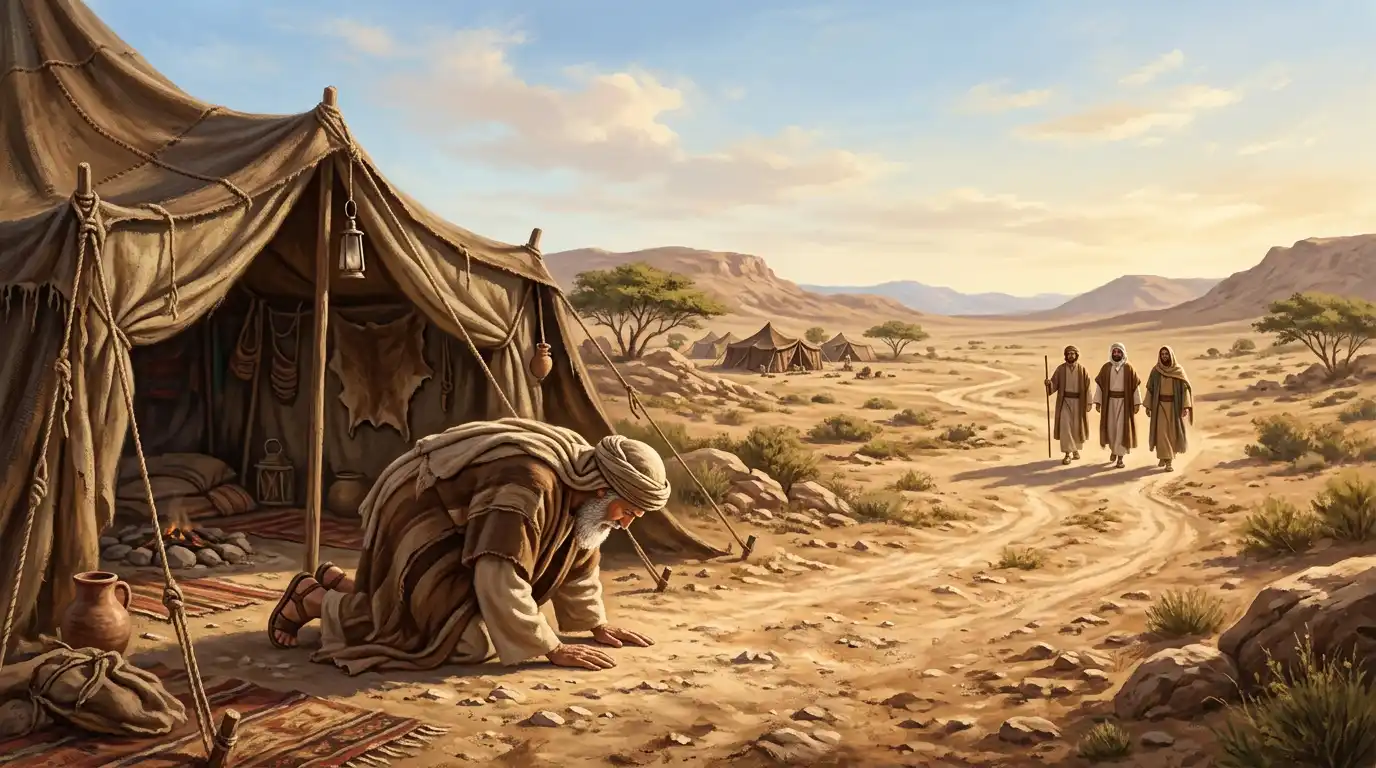
Genesis 18 opens with Abraham sitting at the entrance of his tent "in the heat of the day." When he sees three men approaching, he runs to meet them — not walks. He bows. He begs them to stay. He personally oversees the preparation of a meal of fresh bread, veal, curds, and milk.
This is not Abraham being friendly. This is Abraham performing every required element of the ancient Near East hospitality code at maximum intensity — running, bowing, offering the best food available, serving it personally. The text signals virtue precisely because the ancient reader recognized how rigorously every protocol was being followed.
The payoff is theological: the strangers turn out to be divine messengers. The guest who must be honored might always be God.
Lot in Sodom (Genesis 19)
The Sodom narrative is a direct inversion of Genesis 18. The same divine visitors arrive at Sodom's gate. Lot, like Abraham, runs to meet them and insists they stay with him.
But the men of Sodom surround Lot's house and demand he hand over his guests. In one of the most disturbing passages in the Old Testament, Lot offers his daughters rather than violate the protection-of-guests code. The text is not endorsing this choice — it is showing, with brutal clarity, how absolute the guest-protection obligation was in ancient Near Eastern moral calculus.
The destruction of Sodom is traditionally read as punishment for sexual violence, but Ezekiel 16:49 offers a different primary charge: "She and her daughters were arrogant, overfed and unconcerned; they did not help the poor and needy." Refusing to protect and provide for the vulnerable — including strangers — was the foundational sin.
Rahab and the Spies (Joshua 2)
Rahab, a Canaanite woman in Jericho, hides two Israelite spies in her home and protects them from the king's soldiers. She is an unlikely hero — but her action is entirely consistent with the ancient Near East hospitality code. Once she admitted the spies under her roof, her obligation to protect them overrode city loyalty.
Her protection of the guests is precisely what earns her and her family salvation when Jericho falls.
Why "Washing Feet" Was Not Just Polite
Of all the hospitality rituals in Scripture, foot-washing is the most misunderstood by modern readers.
Today it reads as humble service — the beautiful act Jesus performs in John 13. But to the ancient world, foot-washing was the first and most urgent obligation of any host.
From Dusty Roads to Sacred Ritual
Ancient Near Eastern roads were unpaved. Sandaled travelers on a day's journey accumulated significant dirt, dung, and dust on their feet. In a culture that reclined on cushions to eat — feet pointed outward, near others — unwashed feet were a hygiene and honor problem.
Offering water for foot-washing upon arrival accomplished several things simultaneously:
- It removed literal filth from the guest.
- It communicated immediate acceptance — "you are welcome here."
- It positioned the guest for reclining at a shared meal.
- It signaled that the host was ready to fulfill all further obligations.
Refusing to provide water for foot-washing was a deliberate social snub. Jesus references this directly in Luke 7:44 — when reproving Simon the Pharisee, he says: "You did not give me water for my feet." The omission was not minor. It was a public statement that Jesus was not welcome as an honored guest.
Jesus and the Foot-Washing Tradition
John 13 is not just a lesson in humility — it is a deliberate appropriation of the host's hospitality role. By washing his disciples' feet at the Last Supper, Jesus is doing what a servant or the host's household would do. He is positioning himself as the one who makes the guests — his disciples — fit to receive what is coming.
Peter's shocked refusal ("You shall never wash my feet!") makes perfect sense in this cultural context. What Jesus is doing is socially inverted. A Rabbi performing a servant's hospitable duty for his students was a radical act. The foot-washing is the hospitality code turned upside down as theological statement.
What "Welcoming the Stranger" Really Meant
The Hebrew Bible's commands about welcoming foreigners are not generic calls to be nice. They are rooted in legal obligation and national memory.
The Hebrew Word Ger: Foreigner as Protected Class
The Hebrew word ger (גֵּר) — typically translated "sojourner," "alien," or "stranger" — refers to a foreign-born resident living in Israel without full citizenship rights. The ger was legally vulnerable: no land rights, no tribal protection network, no built-in advocates.
Ancient Near Eastern law codes (including portions of Hammurabi's Code) recognized this vulnerability. In Israel, God himself became the ger's legal protector. Deuteronomy 10:18 declares: "He defends the cause of the fatherless and the widow, and loves the foreigner residing among you, giving them food and clothing."
The 36-Times Commandment
Jewish tradition holds that the command not to oppress the stranger appears 36 times in the Torah — more than any other commandment. The Talmud explains this unusual frequency: "In thirty-six places the Torah warns about the ger because the human inclination is strong to oppress the one who has no protector."
This repetition was legislative reinforcement. The ancient Near East hospitality code was not assumed to operate automatically in a settled, agricultural society the way it did among nomads. It had to be legislated and repeated to survive the transition.
The Role of the Tent in Ancient Hospitality
No object is more iconic to ancient Near East hospitality culture than the tent.
Abraham's Open Door
Genesis 18:1 contains a detail that is easy to miss: Abraham was sitting at the "entrance of his tent." In the ancient Near East, this was a deliberate posture. Sitting at the tent entrance, especially in harsh midday heat, was a signal to approaching travelers: I am watching for you. You are welcome here.
The open tent entrance was a visual advertisement of hospitality. Ancient Bedouin tradition preserved this custom well into the modern era — a tent with an open flap was an invitation; a closed flap was a sign of mourning or absence.
Water Jars and the Gift of Water
In the ancient Near East, offering water was the first and most fundamental act of hospitality. Water was rare, labor-intensive to haul and store, and absolutely essential for life.
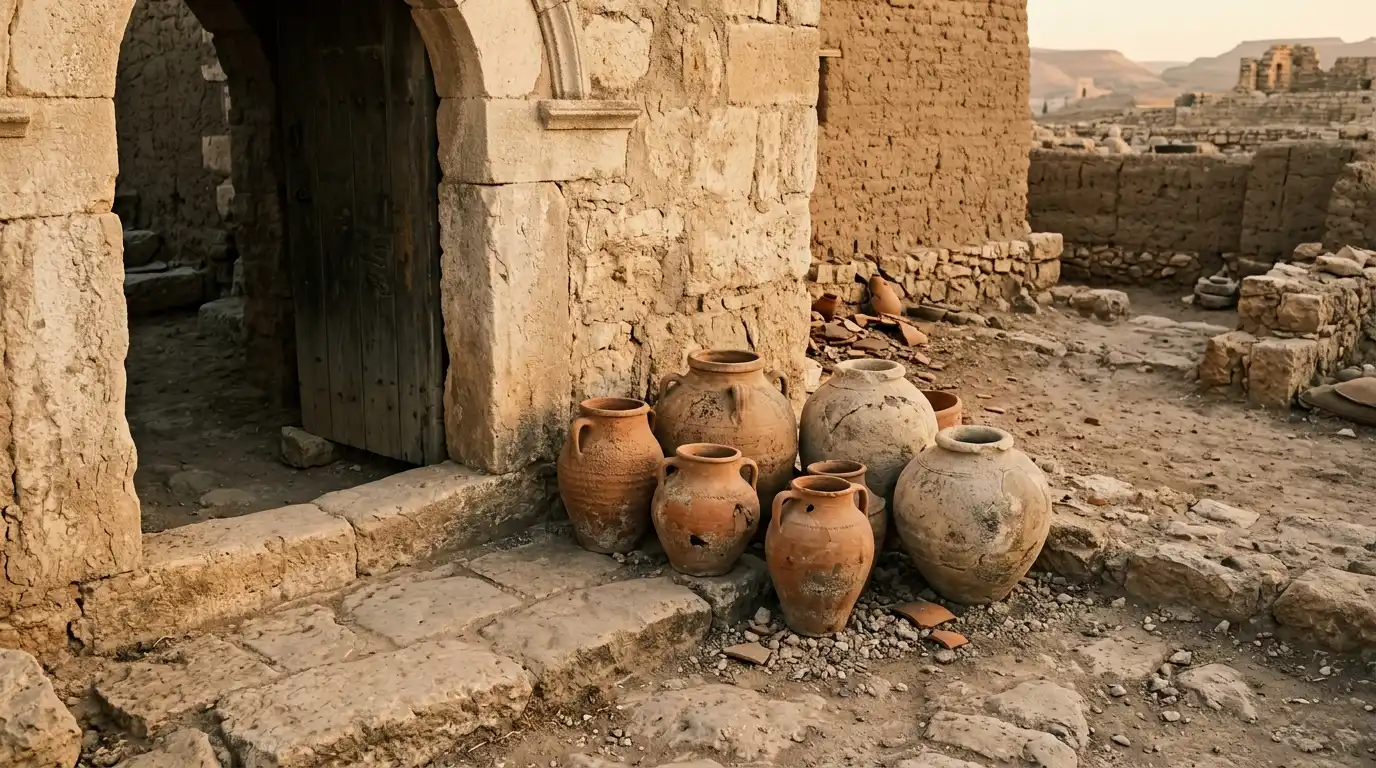
The stone or limestone water jars found throughout ancient Israelite and Canaanite archaeological sites — the same type referenced in John 2:6 during the Wedding at Cana — were household hospitality vessels. Their presence at the door communicated readiness to receive guests.
When Rebekah in Genesis 24 offers water not only to Abraham's servant but also to his camels — unprompted — she is performing the gold standard of ancient Near East hospitality: giving more than asked, to both the guest and their animals. The narrative marks this as the sign that she is the right woman for Isaac. Hospitality is character.
Ancient Near East Hospitality Code vs. Modern Hospitality
The gap between ancient and modern hospitality is enormous. Here is a direct comparison:
| Dimension | Ancient Near East | Modern Western Culture |
|---|---|---|
| Obligation Level | Legal and religious duty | Personal choice |
| Who is owed it | Any stranger at the door | Invited guests only |
| Duration | 3 days minimum before asking purpose | Varies, no fixed rule |
| Questions about guest | Forbidden until day 3 | Immediate and normal |
| Refusal consequence | Public shame, divine judgment | None formal |
| Foot washing / arrival ritual | Mandatory first act | Rare, symbolic only |
| Host's safety responsibility | Legally bound | None formally |
| Reciprocity expected | Yes, built into the code | Generally no |
The ancient code was structural — woven into law, theology, and economics. Modern hospitality is optional — a courtesy, not an obligation.
7 Core Rules of the Ancient Near East Hospitality Code
To summarize, here are the seven binding rules every ancient Near Eastern host was expected to follow:
- Run to meet the approaching stranger — passive waiting was disrespectful.
- Bow in greeting — acknowledge the guest's full human dignity.
- Offer water for foot-washing immediately — before food, before questions.
- Provide the best food available — not leftovers; the finest in the house.
- Ask no questions about the guest's identity or purpose for at least three days.
- Guarantee the guest's physical safety — with your own body and household if necessary.
- Send the guest off with provisions — the obligation did not end at the door.
Why the Ancient Hospitality Code Still Matters Today
The ancient Near East hospitality code is not merely historical trivia for Bible readers. It reshapes how an entire library of biblical texts must be read.
When Jesus says "I was a stranger and you welcomed me" (Matthew 25:35), he is invoking this ancient code — and extending it cosmically. The stranger is not just a vulnerable human. The stranger is potentially the presence of God.
When the early church is described in Acts 2 as sharing meals and goods with all who had need, it is reconstructing the hospitality code in an urban, post-resurrection key. The house church was a tent-entrance thrown perpetually open.
Understanding the code also illuminates the severity of biblical judgment passages. Sodom's destruction, the horrific events of Judges 19 (the Levite's concubine), the divine anger at Israel's oppression of foreigners — all of these make far more sense when you understand that the ancient world considered hospitality a first-order moral category, not a secondary one.
The desert shaped the code. The code shaped Scripture. Scripture carries the code forward — and the stakes, it turns out, are still life and death.
Frequently Asked Questions
What is the ancient Near East hospitality code?
The ancient Near East hospitality code was a set of binding social, legal, and religious obligations governing how hosts must treat travelers and strangers. It required immediate shelter, food, water, and guaranteed safety for any guest — regardless of their identity or origin. Refusing a guest was considered a serious social and spiritual offence.
Why was hospitality so important in the ancient biblical world?
The ancient Near East is desert terrain with scarce water and extreme heat. Travelers who were refused shelter could die of exposure. Hospitality was therefore a survival mechanism — a mutual aid system where every household understood it might someday need a stranger's help in return. This gave the code both practical and moral weight.
What did "washing feet" mean in the Bible?
In the ancient Near East, offering water for foot-washing was the host's first duty upon a guest's arrival. Roads were dusty and unpaved, and sandaled travelers arrived with heavily soiled feet. Washing them communicated immediate welcome and prepared guests to recline at the table. Refusing to offer foot-washing water, as in Luke 7:44, was a deliberate and public snub.
Why does the Bible command Israel to welcome the stranger 36 times?
Jewish tradition counts 36 references in the Torah to protecting and welcoming the ger (stranger or sojourner). Scholars explain this repetition as legal reinforcement — once Israel settled in Canaan, the nomadic hospitality code no longer operated naturally, so it had to be repeatedly legislated. God's own care for the vulnerable foreigner is cited as the theological basis (Deuteronomy 10:18).
What is the connection between Sodom and inhospitality?
While the destruction of Sodom is commonly associated with sexual violence, Ezekiel 16:49 gives a broader indictment: Sodom's sin included being "arrogant, overfed and unconcerned" and failing to "help the poor and needy." The violent demand to hand over Lot's guests (Genesis 19) was the final violation of the guest-protection code — the exact inverse of what the ancient Near East hospitality law required.
What does the Hebrew word ger mean?
Ger (גֵּר) is a Hebrew word meaning "sojourner," "foreigner," or "resident alien" — a person living in Israel without full tribal citizenship. The ger had no land rights or kinship protector, making them legally vulnerable. The Torah repeatedly commands Israel not to oppress the ger, grounding the obligation in Israel's own memory of being "strangers in Egypt" (Exodus 22:21).
How did the ancient Near East hospitality code influence the New Testament?
The New Testament is built on hospitality code assumptions. Jesus' foot-washing in John 13 subverts the host/servant hierarchy of the code as a theological act. His parable of the sheep and goats (Matthew 25) frames welcoming the stranger as welcoming Christ himself. The early church's communal meal sharing in Acts reflects the ancient code reconstructed as covenant community practice.
How long was a guest protected under the ancient Near East hospitality code?
Ancient Near Eastern custom (documented in texts from Ugarit, among other sources) typically required the host to provide hospitality for a minimum of three days before asking the guest's name, origin, or purpose. During this time, the host was fully responsible for the guest's safety and provision. This "three-day rule" appears implicitly in several biblical narratives.
Conclusion
The ancient Near East hospitality code was one of the most powerful social institutions in human history — a survival-driven system that crossed tribal, ethnic, and national lines, enforced by communal shame, theological conviction, and in some cases, legal statute.
When you read the Old Testament with the code in mind, texts that seemed peripheral become central. Abraham running in the heat. Lot barring his door. Rebekah watering the camels. Rahab hiding the spies. The Levite's concubine in Judges 19. The woman who anointed Jesus' feet. None of these stories make full sense without understanding what was at stake.
The "cultural lens" your Bible demands is the lens of the tent — open, facing the road, waiting for whoever comes.
The stranger at the door was always a test. The ancient world knew it. The biblical writers built their theology on it.
For more on the cultural world behind the Bible, explore our Historical Guides — including a deep-dive into what the Last Supper was really like.
Sources: Victor H. Matthews, "Hospitality and Hostility in Genesis 19 and Judges 19," Biblical Theology Bulletin (1992); John J. Pilch & Bruce J. Malina, Biblical Social Values and Their Meaning (Hendrickson, 1993); Frank Anthony Spina, The Faith of the Outsider: Exclusion and Inclusion in the Biblical Story (Eerdmans, 2005); JSTOR — Ancient Near East Hospitality Studies.