 Bible Archivist
March 7, 2026 · John Adams
How to Read Bible Verses Correctly: 3 Proven Steps for Any Passage
Learn how to read Bible verses correctly—from verbal citation notation to contextual interpretation. Master the 3-step hermeneutic method for any passage.

How to Read Bible Verses Correctly: 3 Proven Steps for Any Passage
Reading a Bible verse "correctly" means two things: knowing how to say and cite it out loud (technical notation), and knowing how to understand what it means in its original context (hermeneutical interpretation). This guide covers both so you never misread or misquote Scripture again.
What Does It Mean to Read a Bible Verse 'Correctly'?
Most people assume that reading a Bible verse is straightforward—open the book, find the text, read it aloud. But two very different challenges hide inside that single question.
The first challenge is mechanical. When someone writes "John 3:16" in a sermon note or group study handout, can you say it out loud with confidence? Do you know what the colon means? Can you verbalize a passage range like Psalm 23:1–4 without hesitating?
The second challenge is interpretive. Even if you read the words perfectly, do you understand what they meant to the original audience—before deciding what they mean to you today?
The State of the Bible 2024 report by the American Bible Society found that while the overwhelming majority of U.S. households own at least one Bible, fewer than half of Americans read it on a regular basis. A significant portion struggle not with access to the Bible, but with how to engage it with accuracy and depth. Understanding how to read Bible verses correctly is one of the foundational habits that changes that statistic.
This guide solves both problems—starting with the mechanics.
Part 1: How to Read Bible Citations Out Loud (The Notation Guide)
Before diving into interpretation, let's settle the mechanics. A Bible citation is the address of a specific verse or passage in Scripture. Once you understand the format, reading and saying references becomes second nature.

The Basic Format: Book, Chapter, and Verse
Every Bible reference follows one consistent pattern:
[Book Name] [Chapter]:[Verse]
Here are three examples to make it concrete:
- John 3:16 → The book of John, chapter 3, verse 16
- Psalm 23:1 → The book of Psalms, chapter 23, verse 1
- Romans 8:28 → The book of Romans, chapter 8, verse 28
When you say these out loud, you never pronounce the colon. You say:
- "John three sixteen"
- "Psalm twenty-three one"
- "Romans eight twenty-eight"
What Does the Colon Mean in a Bible Verse?
The colon (:) in a Bible citation is a typographical separator between the chapter number and the verse number. It is a formatting convention, not a spoken punctuation mark. "Genesis 1:1" is spoken as "Genesis one one" or simply "Genesis chapter one, verse one."
How to Read Verse Ranges
When a passage covers multiple verses, a hyphen (–) indicates the range:
- Psalm 23:1–4 → "Psalm twenty-three, verses one through four"
- Matthew 5:3–12 → "Matthew five, verses three through twelve"
When a reference spans multiple chapters:
- Isaiah 40:1–41:10 → "Isaiah chapter forty verse one through chapter forty-one verse ten"
How to Say Numbered Books
Several Bible books carry a number prefix. Always say the number as an ordinal:
- 1 Corinthians → "First Corinthians"
- 2 Timothy → "Second Timothy"
- 3 John → "Third John"
- 1 Corinthians 13:4 → "First Corinthians thirteen four"
Difficult Book Name Pronunciations
Some Bible book names trip up even experienced readers. Here are the most commonly mispronounced:
| Book Name | Correct Pronunciation |
|---|---|
| Habakkuk | huh-BAK-uk |
| Philemon | fih-LEE-mun |
| Deuteronomy | doo-ter-AH-nuh-mee |
| Ecclesiastes | ih-klee-zee-AS-teez |
| Nahum | NAY-hum |
| Obadiah | oh-buh-DY-uh |
Note: Audio Bible apps like the YouVersion Bible App include read-aloud features that let you hear correct pronunciation for every book name and verse.
Common Bible Book Abbreviations
Study notes, commentaries, and cross-references use abbreviated book names. The most common:
| Abbreviation | Full Book Name |
|---|---|
| Gen. | Genesis |
| Ps. / Psa. | Psalms |
| Matt. | Matthew |
| Rom. | Romans |
| 1 Cor. | 1 Corinthians |
| Phil. | Philippians |
| Heb. | Hebrews |
| Rev. | Revelation |
Part 2: The 3-Step Contextual Method for Accurate Interpretation
Now that you can confidently cite a verse, it's time to understand it—and this is where most Bible readers encounter the real challenge.
The discipline of correctly interpreting Scripture is called hermeneutics (her-muh-NOO-tiks). The gold-standard approach used by seminaries and Bible scholars worldwide is the Historical-Grammatical method: reading every text within its literary, historical, and cultural context before applying it to modern life.
Theologian Dr. R.C. Sproul put it precisely: "Exegesis is reading the meaning out of the text. Eisegesis is reading your own meaning into the text. Only one of these leads to truth."
Here is the proven three-step method, used by seminary students and lay readers alike:
- Observation — What does the text actually say?
- Interpretation — What did it mean to the original audience?
- Application — How does it apply to life today?
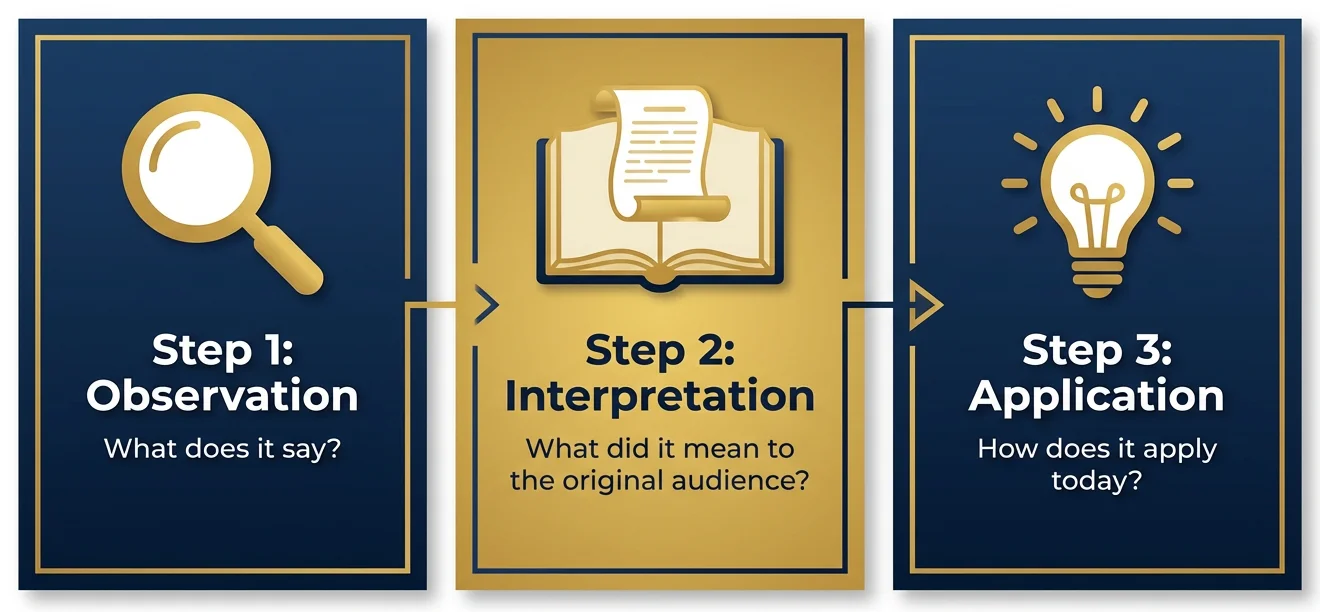
Step 1: Observation — What Does It Say?
Read the verse and its surrounding passage carefully. Resist the urge to jump to meaning. Instead, ask:
- Who is speaking, and to whom?
- What specific action or teaching is described?
- When is this taking place—in history or in the narrative arc?
- Where is the geographical and cultural setting?
- What words or phrases are repeated or emphasized?
For example, before interpreting Jeremiah 29:11 ("For I know the plans I have for you..."), observation reveals that God is addressing Israelites in Babylonian exile—a displaced nation awaiting restoration, not an individual making a career decision in 2026.
Step 2: Interpretation — What Did It Mean to the Original Audience?
This is the heart of exegesis. Your goal: What would this text have meant to the people who first heard or read it?
Consider:
- Historical context: What events and cultural norms shaped the original audience?
- Literary context: What does the surrounding paragraph, chapter, and book contribute?
- Grammatical meaning: What does each key word mean in the original Hebrew or Greek?
- Author's intent: What was the human author trying to communicate to a specific audience?
Gordon D. Fee and Douglas Stuart, in their landmark textbook How to Read the Bible for All Its Worth, describe this step as the most critical: "A text cannot mean what it never meant." The passage must first be understood on its own terms before any personal application is valid.
You don't need to know Hebrew or Greek to do this well. Good Bible study tools for beginners like Blue Letter Bible provide word-by-word original language breakdowns in plain English.
Step 3: Application — How Does It Apply Today?
Once you understand what the text meant, ask what it means for life today. This is where Bible study becomes personally transformative—but only after you've done the exegetical work in Steps 1 and 2.
Ask:
- What timeless principle does this text reveal about God's character, humanity, or redemption?
- Is there a command to obey, a promise to trust, or a warning to heed?
- How does this passage shape how I live, think, or pray this week?
This method is at the heart of any consistent daily devotion practice.
Part 3: Understanding Literary Genre — The Rules of the Road
One of the most overlooked keys to reading Bible verses correctly is recognizing literary genre. The Bible is not one uniform book—it is a library of 66 books written across roughly 1,500 years in multiple genres, and each genre has its own interpretive "rules of the road."
Reading a Psalm with the same literalistic approach you'd use on a legal code produces confusion. Here is how to adjust your lens for three major genres:
Poetry: The Psalms
The Psalms are emotional, metaphorical poetry. When Psalm 91:4 says God will "cover you with his feathers," this is figurative language communicating protection—not a literal description of divine anatomy.
Read poetry looking for:
- Parallelism — Hebrew poetry often restates an idea twice in complementary phrases
- Metaphor and simile — images that communicate feelings and spiritual realities
- Emotional honesty — the Psalms contain lament, rage, and doubt as well as praise
Law: Leviticus and Deuteronomy
The Torah passages containing God's law were given specifically to ancient Israel under the Mosaic Covenant. Not every command in Leviticus applies directly to 21st-century believers in the same way.
When reading law, ask:
- Is this a timeless moral principle (e.g., "do not murder")?
- Or was it a ceremonial law pointing forward to Christ?
- Or was it a civil law governing Israel's specific theocratic society?
Epistles: Romans, Galatians, Ephesians
Paul's letters were written to specific congregations with specific pastoral problems. Context is everything. Reading Ephesians 5:22 ("Wives, submit to your husbands") in isolation—without verse 21 ("submitting to one another") and verse 25 ("Husbands, love your wives as Christ loved the church")—fundamentally distorts the teaching.
Read epistles with:
- The full letter as the immediate context
- Awareness of the congregation's specific historical situation
- An eye toward theological argument, since Paul builds systematic cases across chapters
Understanding how different Bible translations handle these genre distinctions can further sharpen your reading accuracy.
The Danger of Proof-Texting: A Common Pitfall to Avoid
Proof-texting is the practice of pulling a single verse out of its context to prove a predetermined point. It is one of the most widespread misuses of Scripture—and it appears in churches, on social media, and in otherwise well-meaning devotional content.
A frequently cited example: Philippians 4:13 — "I can do all things through Christ who strengthens me."
Read in isolation, it sounds like an open-ended promise of unlimited human achievement. Read in context, Paul is writing from prison and describing his learned contentment whether he experiences abundance or deprivation. The verse is about supernatural peace through suffering—not personal success.
Rule of thumb: A verse can never mean something in isolation that it doesn't mean in its original context. The surrounding paragraph always interprets the single verse.
Recommended Tools for Deeper Study in 2026
You do not need a seminary degree to read Bible verses correctly. These modern tools make scholarly-quality study accessible to everyone:
| Tool | Best For | Cost |
|---|---|---|
| Blue Letter Bible | Word studies, original language breakdowns, commentaries | Free |
| StepBible | Side-by-side interlinear Greek/Hebrew with English | Free |
| Logos Bible Software | Deep academic library, advanced search | Paid |
| YouVersion Bible App | Audio Bible, reading plans, multiple translations | Free |
| AI Bible study assistants | Quick contextual summaries, passage background | Varies |
A word on AI Bible tools: AI assistants can help surface historical background, cross-references, and commentary summaries in seconds. Use them to accelerate your Observation and Interpretation steps. However, always verify AI-generated interpretation against established commentaries and trusted teachers. AI should assist your exegesis—never substitute for it.
Frequently Asked Questions
How do you read a Bible verse citation out loud?
Say the book name, then the chapter number, then the verse number—without saying the colon. "John 3:16" is spoken as "John three sixteen." For verse ranges, say "through" between the numbers: "Psalm twenty-three, verses one through four."
What does the colon mean in a Bible verse?
The colon separates the chapter number (before the colon) from the verse number (after the colon). It is a typographical convention used to format citations. You do not say it when reading a reference aloud.
How do you say 1 Corinthians?
Say "First Corinthians." All numbered Bible books use ordinal pronunciation: 1 Corinthians = "First Corinthians," 2 Timothy = "Second Timothy," 3 John = "Third John." A full citation like 1 Corinthians 13:4 is spoken as "First Corinthians thirteen four."
What is hermeneutics?
Hermeneutics is the science and art of interpreting written texts—particularly Scripture. In Bible study, it refers to the principles and methods used to accurately understand what a passage meant to its original audience and what it means for believers today.
What is the difference between exegesis and eisegesis?
Exegesis (from Greek ex, meaning "out of") means drawing the meaning out of the text based on what it actually says in context. Eisegesis (from Greek eis, meaning "into") means reading your own assumptions or preferences into the text. Sound Bible study always practices exegesis.
What is proof-texting and why is it dangerous?
Proof-texting means using an isolated Bible verse—stripped of its surrounding literary and historical context—to support a claim the text was never intended to make. It is dangerous because it can be used to justify almost any position and misrepresents the author's original intent.
Do I need to know Hebrew or Greek to read Bible verses correctly?
No. Free tools like Blue Letter Bible and StepBible provide English-language breakdowns of every Hebrew and Greek word, with definitions and grammatical notes. They allow anyone to engage original-language study without formal seminary training.
How do I identify which literary genre a Bible book belongs to?
Most study Bibles label genre at the start of each book. As a general guide: Genesis–Deuteronomy (Law/Narrative), Joshua–Esther (Historical Narrative), Job–Song of Solomon (Wisdom/Poetry), Isaiah–Malachi (Prophecy), Matthew–John (Gospel), Acts (History), Romans–Jude (Epistles), Revelation (Apocalyptic).
Conclusion & Next Steps
Reading Bible verses correctly is a two-part skill: mechanical accuracy in citing and vocalizing references, and interpretive rigor in understanding context before drawing conclusions or making application.
Here is your practical starting point:
- Practice citations: Pick five verses today and say them out loud using the correct book-chapter-verse format.
- Apply the 3-step method: The next passage you study, work deliberately through Observation, Interpretation, and Application before drawing personal conclusions.
- Identify your genre: Before reading any passage, pause and ask: Is this narrative, poetry, law, prophecy, epistle, or apocalyptic?
- Refuse to proof-text: Commit to reading every verse in the context of at least its surrounding paragraph—ideally the whole chapter.
The more consistently these principles become habits, the more Scripture will open up—not as a collection of isolated inspirational quotes, but as a coherent, living, historically-grounded narrative that speaks with authority precisely because you are reading it on its own terms.
For a structured framework for putting this into daily practice, see our guide on how to start daily devotions. And when you're ready to choose the right Bible version for exegetical study, see how the major Bible translations compare.
📥 Download the free Context Checklist — a printable one-page reference card for the 3-step contextual method — to keep in your Bible or study journal.